

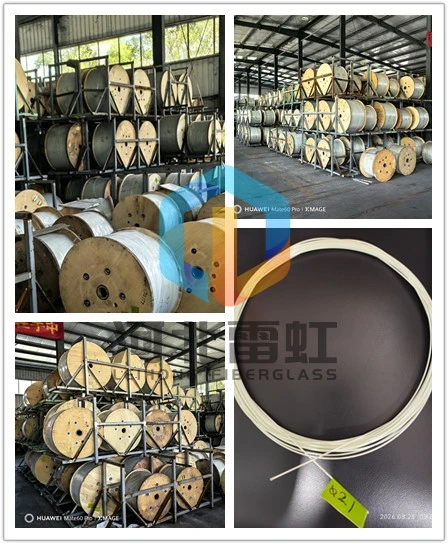
As demand for high-speed communication networks continues to grow, the performance and reliability of fiber optic cables have become increasingly important. Inside many fiber optic cable designs, the FRP rod, also known as a Fiber Reinforced Plastic Rod or GFRP strength member, plays an important structural role.
Made from high-strength glass fibers and resin, FRP rods provide mechanical reinforcement while maintaining the lightweight and non-metallic characteristics required by modern optical fiber cable systems. They are commonly used as a central strength member (CSM) or as peripheral reinforcement in different cable constructions.
What Is an FRP Rod for Fiber Optic Cable?
An FRP optical cable rod is a pultruded composite rod manufactured from glass fiber reinforcement and resin. It is normally positioned at the center of the cable, with optical fiber units arranged around it.
The primary purpose of the FRP rod is to provide mechanical support and help protect the optical fibers from excessive tensile stress during cable installation and operation.
Because FRP is a non-metallic material, it can also provide advantages in applications where electrical insulation and resistance to electromagnetic interference are important.
Why Use GFRP Instead of Metal Strength Members?
Traditional metallic reinforcement can provide mechanical strength, but FRP offers a combination of properties that is particularly useful for optical cable applications.
Lightweight and High Strength
The high strength-to-weight ratio of fiberglass composites allows manufacturers to achieve the required reinforcement without significantly increasing cable weight.
This can make handling, transportation, and installation more convenient, especially for long cable runs.
Non-Metallic and Electrically Insulating
FRP is non-conductive and does not introduce the same electrical conductivity associated with metallic reinforcement. This makes FRP strength members suitable for cable designs requiring an all-dielectric structure and for installations near electrical infrastructure.
Corrosion Resistant
FRP does not rust like steel. Its corrosion resistance makes it suitable for optical cables used in outdoor, humid, coastal, and other demanding environments.
Good Dimensional Stability
A high-quality FRP rod requires a smooth and consistent surface, stable diameter, and controlled mechanical properties. These characteristics help maintain consistent performance during cable manufacturing.
FRP Rod as a Central Strength Member
One of the most common applications is the central strength member (CSM).
In this construction, the FRP rod is positioned in the center of the optical cable, while optical fiber tubes or other cable components are arranged around the rod.
The central member provides rigidity and tensile reinforcement while helping protect the optical fibers during cable installation.
FRP central strength members can be used in various cable constructions, including:
Outdoor fiber optic cables
Indoor optical fiber cables
FTTH cables
ADSS cable designs
Loose tube optical cables
FTTx communication cables
FRP Rod Manufacturing by Pultrusion
The manufacturing process is based on continuous pultrusion technology.
Glass fiber reinforcement is impregnated with resin and continuously pulled through a forming and curing system to create a stable FRP rod.
The production process allows manufacturers to control:
Rod diameter
Resin and glass fiber composition
Surface finish
Mechanical strength
Dimensional tolerance
Continuous production length
The resulting product can be supplied in long continuous lengths and wound onto reels for convenient transportation and cable manufacturing.
Commercial FRP optical cable rods are available in a range of diameters, with examples in the market covering approximately 0.4 mm to 5.0 mm, depending on cable design and application requirements.
Customized FRP Optical Cable Rods
Different fiber optic cable constructions require different strength-member dimensions and mechanical properties.
For this reason, customized FRP rods can be produced according to customer requirements, including:
Diameter | Tensile Strength | Tensile Modulus | Surface Finish | Coating | Reel Length
The exact specification should be selected according to the cable structure, installation conditions, and customer's technical requirements.
Quality Is Critical for FRP Cable Strength Members
As the FRP rod is an important structural component of the cable, consistency is essential.
Typical quality considerations include tensile strength, tensile modulus, diameter tolerance, surface quality, bending performance, and temperature resistance. Published product specifications for optical cable FRP rods commonly specify high tensile strength and tensile modulus together with controlled diameter stability.
A smooth and uniform surface is also important for compatibility with the surrounding cable components and for stable performance during cable manufacturing.
FRP Rod Manufacturer and Supplier
With the continuous development of fiber optic communication networks, demand for reliable GFRP and FRP strength members continues to grow.
FRP rods provide a practical combination of high strength, low weight, corrosion resistance, electrical insulation, and dimensional stability, making them an important composite component for modern optical fiber cables.
For customers looking for customized FRP Rod / GFRP Rod / FRP Strength Member for Fiber Optic Cable, we can provide products according to required diameter, mechanical properties, coating and packaging specifications.
Contact Us
Hebei Leihong Fiberglass Technology Co., Ltd.
📧 Email: alina@leihongfrp.com
📱 WhatsApp: +86 15373182207