

Fiberglass Reinforced Plastic (FRP) gratings are increasingly used in industrial platforms, wastewater treatment plants, chemical environments, and public infrastructure due to their corrosion resistance, mechanical strength, and long service life. Among the various types available, molded gratings and pultruded gratings are the most widely used. This article walks you through how FRP gratings are made and the key differences between the two main types.
1. How FRP Gratings Are Made
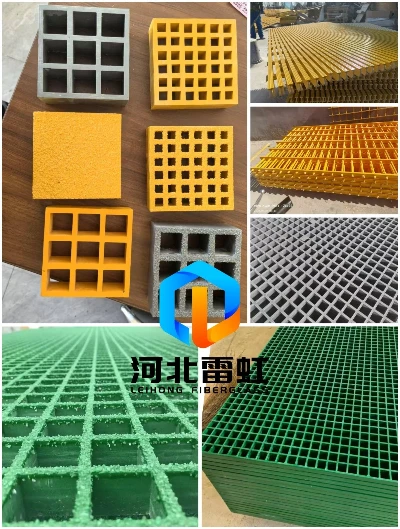
a. Raw Materials
FRP gratings are made from glass fiber reinforcements and thermosetting resins such as isophthalic polyester, vinyl ester, or phenolic resin.
Fiberglass provides structural strength.
Resin offers chemical resistance, flame retardancy, and bonding integrity.
b. Molded Grating Process
In the molded process, chopped fiberglass strands are laid into a steel mold and saturated with resin. The mixture is layered in a crisscross structure and cured at high temperature. Once cured, the grating is demolded and trimmed.
Advantages:
- Uniform strength in both directions
- High corrosion resistance
- High open area (up to 70%)
- Easier to cut and shape
c. Pultruded Grating Process
Pultruded gratings are manufactured by pulling continuous fiberglass rovings through a resin bath and then curing them through a heated die. This process creates bearing bars with continuous fibers in one direction.
Advantages:
- Higher strength in load-bearing direction
- Ideal for long spans and heavy loads
- Precise dimensions and consistent profiles
2. Molded vs. Pultruded Grating: Key Differences
|
Feature |
Molded Grating |
Pultruded Grating |
|
Manufacturing |
Resin + chopped strand in mold |
Continuous roving pulled & cured |
|
Strength Direction |
Bidirectional |
Unidirectional (high in one direction) |
|
Span Capability |
Moderate |
High |
|
Open Area |
High (up to 70%) |
Lower |
|
Chemical Resistance |
Excellent |
Very good |
|
Design Flexibility |
Easy to cut/shape |
Limited shapes |
|
Cost |
More economical |
Higher due to process complexity |
|
Applications |
WWTP, drainage covers, walkways |
Power plants, offshore platforms, heavy-duty access |
3. Surface & Finishing Options
FRP gratings are available in different surface finishes:
Concave – for general anti-slip
Gritted – for extra slip resistance
Covered top – for hygiene or safety Additional treatments like UV-resistant coating and fire retardant options are also available depending on the environment.
4. Application Fields
Both molded and pultruded gratings are used in:
Wastewater Treatment Plants (WWTP)
Chemical factories and refineries
Power plants and cooling towers
Marine decks and walkways
Public infrastructure (e.g., trench covers, platforms)
Electrical stations (due to non-conductivity)
Conclusion
Choosing the right type of FRP grating depends on your project's structural, chemical, and environmental needs.
Choose molded gratings for excellent corrosion resistance, high open area, and design flexibility.
Choose pultruded gratings for long spans, heavy load-bearing needs, and high mechanical strength.
At Hebei Leihong FRP Technology Co., Ltd., we offer both molded and pultruded gratings with custom sizes, surface options, and color choices. Contact us today for technical support or a tailored solution.