

Choosing the right cable tray material can make a significant difference in corrosion resistance, installation costs, maintenance requirements, and long-term performance.
In industrial environments, cable trays are essential for supporting and organizing power and control cables. However, traditional metal cable trays may suffer from rust and corrosion in wastewater treatment plants, chemical factories, coastal facilities, and other demanding environments. Frequent maintenance and replacement can increase the total cost of ownership.
As non-metallic alternatives become more widely used, FRP fiberglass cable trays and polymer cable trays are attracting attention from engineers, contractors, and industrial equipment buyers.
But which material is better? The answer depends on your operating environment, load requirements, fire safety standards, and budget.
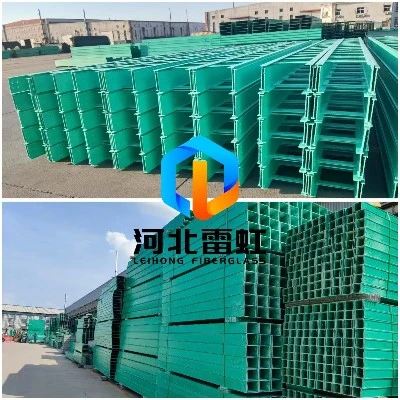
1. What Is an FRP Fiberglass Cable Tray?
FRP stands for Fiber Reinforced Plastic. These cable trays combine glass fiber reinforcement with a resin matrix to create a lightweight structural material.
FRP cable trays are commonly manufactured using pultrusion or molding processes. They are available in various configurations, including ladder-type, trough-type, and covered cable trays.
Key Advantages of FRP Cable Trays
Excellent corrosion resistance
Unlike steel, FRP does not rust. With an appropriate resin system, FRP cable trays can resist many acids, alkalis, salts, and corrosive industrial environments. Vinyl ester resin options may be suitable for more aggressive chemical exposure than standard polyester systems, depending on the specific conditions.
Lightweight and easy to install
FRP is generally lighter than comparable steel cable tray systems, making transportation and handling easier. Proper structural sizing is still essential to meet cable loads and support spans.
Electrical insulation
FRP is nonconductive and nonmagnetic, which can be beneficial in applications requiring electrically insulating cable support systems. However, it must not be treated as a substitute for required electrical grounding and bonding arrangements.
Suitable for demanding industrial environments
FRP cable trays are widely used in chemical processing, wastewater treatment, oil and gas facilities, and coastal installations where corrosion resistance is an important consideration.
 2. What Is a Polymer Cable Tray?
Polymer cable trays are made from polymer-based materials. Depending on the manufacturer, the material may be an unreinforced or reinforced thermoplastic, a composite polymer, or another engineered plastic formulation.
The term "polymer cable tray" covers a broad range of products, so performance varies considerably between materials and product designs.
Potential Advantages of Polymer Cable Trays
Corrosion resistance: Many polymer materials resist moisture and selected chemicals without rusting.
Lightweight construction: Polymer trays can be convenient to handle and install.
Flexible product design: Manufacturers may offer different colors, shapes, sizes, and configurations.
Low maintenance: Suitable materials can reduce the need for corrosion-related coating repairs.
However, not every polymer cable tray offers the same structural strength, temperature resistance, UV durability, or fire performance. Buyers should check the specific material composition and independently verified technical data before selecting a product.
3. FRP vs. Polymer Cable Trays: Key Differences
| Comparison | FRP Fiberglass Cable Tray | Polymer Cable Tray |
|---|---|---|
| Material structure | Glass fiber reinforced resin | Depends on polymer type and reinforcement |
| Corrosion resistance | Excellent with suitable resin selection | Depends on the specific polymer and chemicals |
| Mechanical performance | Designed for structural cable support; verify load ratings | Varies by material, design, and reinforcement |
| Electrical properties | Generally nonconductive | Generally nonconductive, depending on formulation |
| Outdoor use | Suitable with appropriate UV protection and specifications | Depends on UV stabilization and material properties |
| Fire performance | Flame-retardant grades and certified options available | Depends on formulation and product certification |
| Customization | Various profiles, widths, heights, and configurations | Depends on manufacturing process and product range |
| Best selection criteria | Structural loading and demanding industrial environments | Application-specific requirements and verified material performance |
Important: FRP is itself a type of fiber-reinforced polymer composite. Therefore, the comparison is not simply between "fiberglass" and "polymer." The actual resin, reinforcement, structural design, and test results determine product performance.
4. Which Cable Tray Is Better for Your Application?
For Chemical Plants and Wastewater Treatment Facilities
FRP cable trays are worth considering when corrosive gases, chemical splashes, moisture, or wastewater create persistent corrosion problems.
The resin system should be selected according to the actual chemicals, concentrations, and temperatures. For especially aggressive environments, a suitable vinyl ester system may offer advantages over standard polyester resin.
For Outdoor and Coastal Projects
Both FRP and polymer trays may be suitable, but UV exposure, salt spray, temperature changes, wind loading, and installation conditions must be considered.
Ask the manufacturer for relevant UV, corrosion, mechanical, and fire-performance data rather than choosing solely by product appearance or price.
For Projects With Strict Fire Safety Requirements
Neither material should be assumed to be fireproof. Confirm the required flame spread, smoke generation, halogen content, and applicable project standards. Select a product with test reports or certifications that match the specification.
For Budget-Sensitive Projects
Compare more than the initial purchase price. Installation labor, accessories, support spacing, maintenance, replacement frequency, and expected service life all contribute to the total cost.
A properly specified cable tray may provide better long-term value even if its initial price is higher.
5. Why Consider Leihong FRP and Polymer Cable Trays?
Hebei Leihong Fiberglass Technology Co., Ltd. manufactures FRP cable trays and provides polymer cable tray options for different industrial and infrastructure applications.
Our product range includes:
FRP fiberglass ladder cable trays
FRP trough-type cable trays
Polymer cable trays
Customized widths, heights, and lengths
Bends, tees, reducers, and other compatible accessories, subject to the selected system
As a direct manufacturer, we can discuss your project drawings, cable loads, installation environment, and dimensional requirements to help identify a suitable product configuration.
We focus on customized manufacturing, quality control, and competitive factory-direct pricing.
Conclusion: Choose the Right Material, Not Just the Newest Material
So, which is better: FRP fiberglass cable trays or polymer cable trays?
For projects where structural cable support and demanding corrosion resistance are major priorities, FRP is often a strong candidate. Polymer cable trays can also be suitable when their specific material properties meet the project's mechanical, environmental, and safety requirements.
The best choice depends on your application-not simply whether a material is newer or cheaper.
Contact Leihong to discuss your cable tray requirements and request a customized quotation.
Hebei Leihong Fiberglass Technology Co., Ltd.
Email: alina@leihongfrp.com
WhatsApp: +86 15373182207
Website: www.frpgratingcover.com
Keywords: FRP cable tray, fiberglass cable tray, polymer cable tray, FRP vs polymer cable tray, corrosion-resistant cable tray, ladder cable tray manufacturer, trough cable tray, customized cable management systems.